
Frequently Asked Questions
What is the Japanese alphabet?
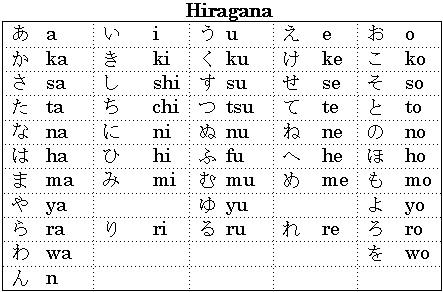
Japanese has two alphabets: hiragana and katakana. In English, there is only one alphabet, so it is called "the alphabet." But in Japanese, there are two alphabets which together are called kana.
Hiragana is used for Japanese words and for grammatical elements.
Katakana is used for words borrowed from other languages. Specifically katakana is used for nouns such as names, place names, chemical names, and so on. If you see a word in katakana that is not recognizable to you, it may still be a borrowed word. For example, bread in Japanese is pan which is written in katakana because it is borrowed from the French.
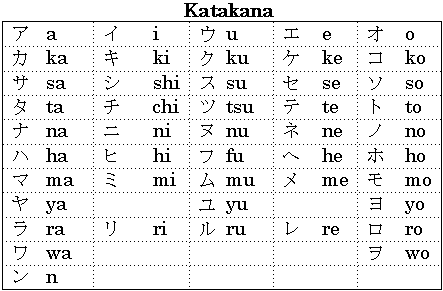
If you happen upon an old book, say one written before World War II, you will find that katakana was used then like hiragana is used today.
In English, we have borrowed words from Japanese, but we write them using the same alphabet. Examples of words we have borrowed from Japanese are karaoke, karate, and sushi.
Example 1
My name is Eri and when I write my name in kana, I write it in hiragana. Eri in hiragana is written: えり
My husband's name is Tim and he writes his name in katakana. Tim in katakana is written: ティム
Example 2
To say "I am Eri" in Japanese is watakushi wa eri desu.
わたくしはえりです
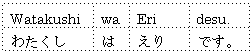
To say "I am Tim" is watakushi wa timu desu.

The careful reader will see that the "wa" in "watakushi" and the stand-alone "wa" are different. Looking at the hiragana table, you will find that the "wa" in "watakushi" is the "wa" that you would expect. But the stand-alone "wa" is actually "ha". There are very few exceptions to rules in Japanese and this is one of them. While this stand-alone "wa" is pronounced "wa", it is written as "ha".
Besides two alphabets (each with 46 syllables), Japanese also has pictographs and ideographs called kanji or Chinese characters. In school, a Japanese student will have to learn at least 1,945 kanji.
When I sign my name, depending on the work, I would not use hiragana, but rather I would use kanji. In kanji, Eri is written 英利 and it means "Brave and Clever".
So if I were to write "I am Eri" in Japanese, I would use the kanji for "I" and for "Eri".
Example 3
In Japanese, karaoke is written in katakana as カラオケ. This is because karaoke is actually not entirely a Japanese word. Are you familiar with the word karate? Karate means "empty-handed" — kara means empty and te means hand. The kanji for karate is 空手. Therefore karaoke must be an empty something. That something is oke which is an abbreviation for "orchestra". So karaoke means "empty-orchestra". And when we think that karaoke is music without the singing, it all makes sense.

