
How to Write Names in Hiragana
Hiragana 平仮名 is the flowing, curved script of the Japanese language. I am often asked by women to write their name in hiragana rather than the standard katakana — and I understand why. It gives the name a softer, more Japanese feel, as if it has been welcomed into the language rather than marked as foreign.
For an overview of all four methods, see How to Write Names in Japanese.
A Brief History
Hiragana is attributed to the Buddhist priest Kūkai (AD 774–835) and was famously adopted by the poetesses of the Heian period (794–1185), who considered the angular katakana to be masculine and preferred a more expressive script. Hiragana was known as 女手 onnade, "feminine hand" — a flowing syllabary particularly well suited for semi-cursive and cursive calligraphy.
Today hiragana is used to write grammatical elements, verb and adjective inflections, and native Japanese words for which kanji either does not exist or is not commonly used. In Japan, both male and female given names can be written in hiragana, so there is no hard gender distinction. For non-Japanese names, however, choosing hiragana over the standard katakana is a deliberate aesthetic decision.
As hiragana offers the full range of calligraphy fonts — block, semi-cursive, and cursive — it is much more suitable for Japanese calligraphy than katakana, which is limited to block styles.
The Hiragana Character Set
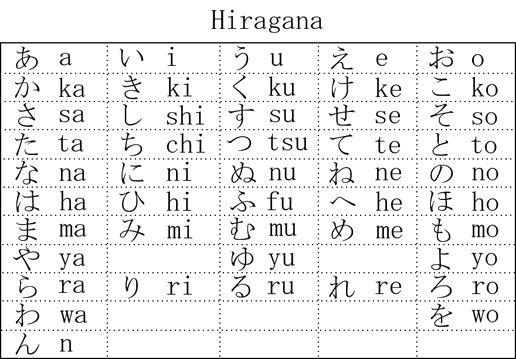
Like katakana, hiragana uses dakuten (voicing mark) and handakuten (semi-voicing mark) to create additional sounds.
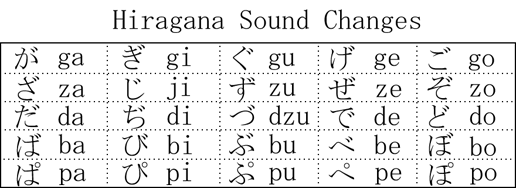
Hiragana also uses small characters (shōji) for palatalized syllables (yōon) and geminated consonants (sokuon).
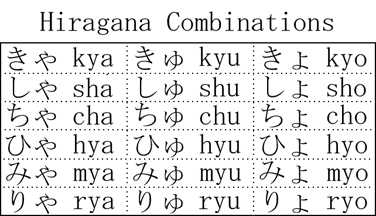
How Hiragana Differs from Katakana
Katakana has been modified over the years specifically to handle non-Japanese sounds. It has an extended set of characters — combinations using small vowels and voicing marks — that can approximate sounds like V, F, and W + vowel. Hiragana does not have the same modifications. When a foreign name enters hiragana, some sounds must adapt.
There are three changes to be aware of, and they are simple once you see the pattern.
V becomes B
The V-series (ヴァ, ヴィ, ヴ, ヴェ, ヴォ) exists only in katakana. In hiragana, V maps to B. "Vivian" in katakana preserves the V: ヴィヴィアン. In hiragana, it becomes びびあん — the V softens to B throughout.
F becomes H
The F-series (ファ, フィ, フェ, フォ) also exists only in katakana. In hiragana, F maps to H. "Sofia" in katakana is ソフィア. In hiragana, it becomes そひあ — the fi sound softens to hi.
W-vowel becomes a vowel pair
Katakana creates W-sounds with small combining characters (ウィ, ウェ, ウォ). Hiragana does not have these, so they become simple vowel combinations: うい (ui), うえ (ue), うお (uo). "William" in katakana is ウィリアム. In hiragana, it becomes ういりあむ.
What does NOT change
Sounds like ti (ティ/てぃ), di (ディ/でぃ), che (チェ/ちぇ), she (シェ/しぇ), and je (ジェ/じぇ) use small kana construction that works identically in both scripts. "Chelsea" is チェルシー in katakana and ちぇるしい in hiragana — the che sound is the same.
Quick reference
| Katakana | Hiragana | Rule |
|---|---|---|
| ヴァ ヴィ ヴ ヴェ ヴォ | ば び ぶ べ ぼ | V → B |
| ファ フィ フェ フォ | は ひ へ ほ | F → H |
| ウィ ウェ ウォ | うい うえ うお | W → vowel pair |
| ティ ディ トゥ ドゥ | てぃ でぃ とぅ どぅ | No change |
| シェ ジェ チェ | しぇ じぇ ちぇ | No change |
Long Vowels: The Biggest Difference
This is the most visible difference between katakana and hiragana name designs, and it is worth understanding well.
Katakana uses the chōonpu (ー), a dash-like mark, to extend any vowel sound. Kelly ends with a long "ee": ケリー. Simple, clean, unambiguous.
The chōonpu does not exist in hiragana. Instead, long vowels are written by doubling the vowel character:
| Long sound | Katakana | Hiragana | What happens |
|---|---|---|---|
| Long a | ー (after ア-row) | ああ | a + a |
| Long i | ー (after イ-row) | いい | i + i |
| Long u | ー (after ウ-row) | うう | u + u |
| Long e | ー (after エ-row) | ええ | e + e |
| Long o | ー (after オ-row) | おう | o + u (not o) |
The long "o" is the one exception — it doubles as おう (o + u) rather than おお (o + o), following standard Japanese orthographic convention.
Kelly in both scripts:
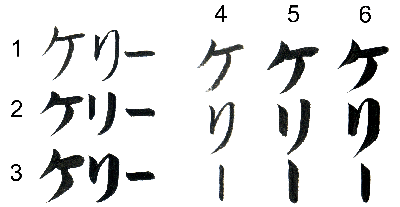
Kelly in katakana: ケリー (kerī) — the final long vowel uses the chōonpu.
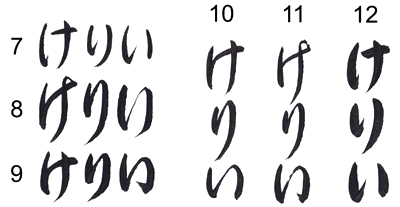
Kelly in hiragana: けりい (kerii) — the final long vowel doubles the い.
A Practical Example: David
The name David illustrates several of these differences working together:
| Katakana | Hiragana | |
|---|---|---|
| Characters | デイヴィッド | でいびっど |
| Romaji | deividdo | deibiddo |
| What changed | ヴィ preserves V | び substitutes V to B |
In katakana, the extended ヴィ (vi) keeps the original V sound. In hiragana, this becomes び (bi) — the nearest native Japanese equivalent. Both are correct renderings of the same name in different scripts, each with its own aesthetic and cultural character.
When to Choose Hiragana
Hiragana is a strong choice when:
- Calligraphic expression matters. Hiragana supports all fonts including cursive (sōsho) and semi-cursive (gyōsho), where the brush flows between characters. Katakana is limited to block styles.
- You prefer a softer, more Japanese aesthetic. Hiragana's flowing curves give the name a different visual character from katakana's angular strokes.
- The sound substitutions are acceptable. If your name contains V, F, or W-vowel combinations, these will change. For many names this does not matter — but if preserving a V sound is important to you, katakana is the better choice.
- You are creating a design for display, not identification. For documents, business cards, or contexts where a Japanese reader needs to identify a foreign name, katakana is expected. For art, gifts, and personal items, hiragana is a beautiful alternative.
Keep in mind that hiragana has its limits for some combinations. The Hawaiian place name "Ka'a'awa" is easy to render in katakana, where each vowel can be shown individually: カアアヴァ. In hiragana, the consecutive vowels would be ambiguous. As a practical matter, most Western personal names do not present this kind of difficulty.
Summary
Hiragana offers what katakana cannot: flowing brushwork, cursive expression, and a warm, Japanese aesthetic. The trade-off is that some foreign sounds must adapt — V softens to B, F softens to H, and long vowels are written differently. For most names, these changes are subtle. And in my experience, the result is often more beautiful than the katakana version.
For the standard phonetic rendering, see How to Write Names in Katakana. For designs that carry meaning or require seal script, see How to Write Names in Kanji.