
How to Write Names in Japanese
There are four ways to write names in Japanese. Only one — a phonetic translation to katakana — is considered standard. This is how non-Japanese names appear in Japanese newspapers, magazines, and on Wikipedia. If you want to be strictly correct, use katakana.
With that said, there are compelling reasons to choose one of the other three methods. Some are aesthetic: katakana is angular and limited calligraphically, while hiragana has naturally flowing curves suited to semi-cursive and cursive brushwork. Others are about meaning: kanji characters carry meaning, so a name can become a personal statement — "gentle tiger" or "garden dream" — rather than just a sequence of sounds.
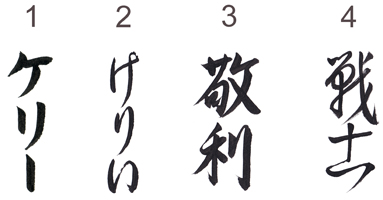
Note that in Japan, katakana and hiragana are used by males and females. Though kanji is by far the most commonly used for native Japanese given names.
Why Names Change in Japanese
Before choosing a method, it helps to understand why your name will look and sound different in Japanese. It is not because the translation is imprecise — it is because the two languages organize sound in fundamentally different ways.
Japanese builds nearly every syllable from one consonant followed by one vowel. The only exceptions are standalone vowels (a, i, u, e, o), the syllabic n, and doubled consonants. This gives Japanese roughly 100 distinct syllables. English uses thousands of possible syllable shapes.
When a foreign name enters Japanese, it must be rebuilt entirely from this smaller set of building blocks. The name "Mark," one syllable in English, becomes ma-ru-ku — three syllables in Japanese. Every consonant cluster gets split apart, and final consonants gain a following vowel.
This is not an error. It is the natural result of expressing one language's sounds through another language's structure. The goal is a version of your name that a Japanese speaker can pronounce naturally and that you can still recognize as yours.
Some sounds substitute
Several sounds common in English have no direct equivalent in Japanese:
- L and R — Japanese has a single sound in this space, somewhere between the two. "Larry" and "Rally" produce identical Japanese.
- TH — The "th" in "Catherine" becomes sa (voiceless TH maps to S). The "th" in "the" maps to D.
- V — In katakana, a modern extended set can approximate V. In hiragana, V sounds map to B, so "Vivian" becomes "Bibian."
Names get longer
Because Japanese adds vowels after consonants, names typically gain syllables:
| English | Japanese | What happened |
|---|---|---|
| Smith | su-mi-su | "sm" split apart; final "th" adapted |
| Brad | bu-ra-do | "br" split; final "d" gains a vowel |
| Christine | ku-ri-su-ti-n | Every cluster split; final 'n' stays |
The more consonant clusters and final consonants a name has, the longer it becomes in Japanese. This is normal and expected.
The Four Methods
1. Phonetic Translation to Katakana
The standard way to write foreign names. Katakana is angular and crisp, immediately signaling "this is a foreign word" to Japanese readers. It has been extended over the years to handle sounds that don't exist in native Japanese, making it the most accurate phonetic rendering.
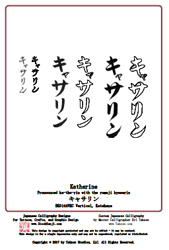
Best for: Accuracy, standard usage, names that will be read by Japanese speakers.
Limitation: Angular strokes leave little room for calligraphic expression. No cursive or semi-cursive fonts exist for katakana. Seal script (tensho) is also unavailable, since it predates katakana by thousands of years.
Read more: How to Write Names in Katakana
2. Phonetic Translation to Hiragana
The aesthetic alternative. Hiragana is flowing and curved — historically called onnade or "feminine hand," though it is used by everyone in modern Japan. Writing a foreign name in hiragana gives it a softer, more Japanese feel, as if the name has been welcomed into the language rather than marked as foreign.
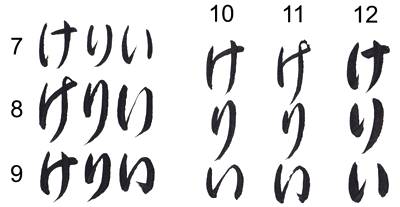
Best for: Feminine aesthetics, cursive calligraphy, designs where flowing lines matter.
Trade-off: Hiragana does not have all the extended characters that katakana has. Some sounds must substitute — V becomes B, F becomes H. The result sounds slightly more Japanese and slightly less like the original name.
Read more: How to Write Names in Hiragana
3. Phonetic Translation to Kanji (Ateji)
A phonetic translation to kanji is known as ateji (当て字, "assigned characters"). The sound of your name is preserved, but each syllable is written with a kanji that carries meaning. The result is a name that sounds like you but says something — "man of fire," "gentle tiger," "mercy, grace, benevolence."
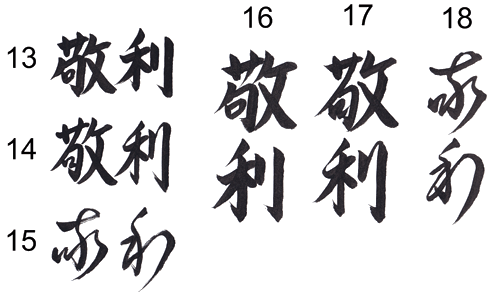
Best for: Names of one to three syllables, seal designs, all calligraphy fonts, personal meaning.
Trade-off: Not every syllable maps cleanly to kanji. Longer names require more characters, making meaningful combinations harder to find. Most people will not be able to read the name correctly on sight, since each kanji can have many possible pronunciations.
Read more: How to Write Names in Kanji
4. Literal Translation to Kanji
With a literal translation, the meaning of the name is translated rather than the sound. The name "Violet" becomes 菫 (sumire, "violet"). The name "Hunter" becomes 狩人 (kariudo, "hunter"). The pronunciation changes entirely, but the meaning carries through.
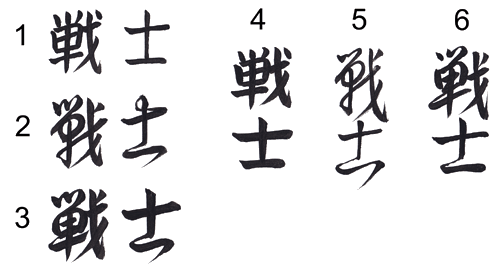
Best for: Names that are common words (Angel, Rose, Joy, Liberty, Hunter, Star), names where the meaning is personally significant.
Limitation: Many names have lost their original meaning or have meanings that don't translate gracefully. The pronunciation will be completely different from the original name.
Read more: How to Write Names in Kanji
Pronunciation Determines the Translation
For all three phonetic methods, the translation follows the pronunciation of your name — never the spelling. The names "Kathy" and "Cathy" produce identical Japanese. The name "Jan," pronounced with a J (American) versus a Y (European), produces two different translations.
This is why we provide the pronunciation alongside every design. If a website offers Japanese name translations without asking how you pronounce your name, be cautious — the translation may not match your pronunciation.
Our system has transliteration rules for names from 13 languages, because the source language profoundly affects how the same spelling should be pronounced. Consider the name "Gigi": an English speaker likely says JEE-jee, an Italian speaker also says JEE-jee (G before I is always soft in Italian), but a French speaker says zhee-ZHEE. Same four letters, different Japanese renderings.
Choosing the Right Method
| Priority | Recommended Method |
|---|---|
| Standard usage, accuracy | Katakana |
| Feminine or flowing aesthetics | Hiragana |
| Personal meaning + sound | Kanji (ateji) |
| Preserve name's original meaning | Kanji (literal) |
| Seal design (tenkoku) | Kanji (either method) |
| All calligraphy fonts available | Hiragana or Kanji |
You may also combine methods. I am reminded of the Denny Crane character from the TV series Boston Legal. In one episode his name appeared in Japanese as デニー鶴 — first name translated phonetically to katakana, surname translated literally to kanji using the character 鶴 meaning "Crane."
What to Expect
Even with good preparation, a few things about your Japanese name may surprise you.
Some names have multiple valid versions. If your name has an ambiguous pronunciation — "Andrea" can be AN-dree-uh or on-DRAY-uh — there will be multiple Japanese renderings. Each is correct for a different pronunciation. This is a feature, not confusion.
Katakana and hiragana versions may differ. In katakana, a modern extended series preserves sounds like V. In hiragana, V becomes B, so "Valerie" becomes barerii. Both are correct renderings in different scripts — see the hiragana article for why.
Reading your Japanese name
When you see your name in Japanese for the first time, sound it out one character at a time. Each character is one beat. Give each character equal time — Japanese rhythm is even and flat compared to English stress patterns.
Every design includes a pronunciation guide called romaji — Japanese sounds written in Roman letters. When you see maikeru next to "Michael," the romaji tells you: yes, that is your name, rebuilt in Japanese sounds.
Summary
Transliteration is interpretation. Two equally qualified transliterators might produce slightly different Japanese for the same name. Our renderings follow established conventions backed by over 30 years of Master Takase's expertise, but "the one correct answer" rarely exists. Multiple versions are normal and let you pick the one that feels most like your name.
Beyond the transliteration, Master Takase's brushwork gives each design its own character. The pronunciation gets you to the right sounds. The calligraphy makes it art.