
How to Write Names in Kanji
Kanji are Chinese characters adopted into Japanese, each carrying one or more meanings and multiple possible pronunciations. When used for names, kanji bring something that neither katakana nor hiragana can offer: meaning. A name can become a personal statement rather than just a sequence of sounds.
There are two ways to write names in kanji:
- Phonetic translation (ateji) — the sound of your name is preserved, but each syllable is written with a meaningful kanji.
- Literal translation — the meaning of your name is translated to Japanese, but the pronunciation changes entirely.
For an overview of all four methods, see How to Write Names in Japanese.
Phonetic Translation: Ateji
A phonetic translation to kanji is known as 当て字 ateji, meaning "assigned characters." There is a long tradition of using ateji that goes all the way back to when Chinese was first adapted to write Japanese.
The idea is elegant: each syllable of your name is matched to a kanji that has the right pronunciation and carries a beautiful meaning. The result is a name that sounds like you but says something — a small poem composed from the sounds of your name.
How It Works
Each kanji covers one to three morae (syllable-beats) of your name's pronunciation. I select kanji whose readings match the target sounds and whose meanings combine into something beautiful or personally meaningful.
For example, the name Oscar means "spear of the gods" in Old English. In Japanese, Oscar is osukā, which can be written phonetically with the characters 雄火 — o (雄, "man, heroic") and suka (火 is read ka meaning "fire") — giving us "man of fire."
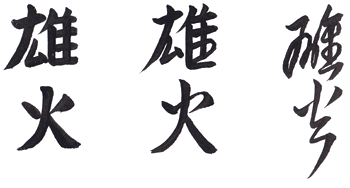
Oscar written phonetically in kanji meaning "man of fire"
Another example: Tim can be translated as teimu using the characters 底夢 meaning "garden dream" — a particularly nice choice for a gardener.
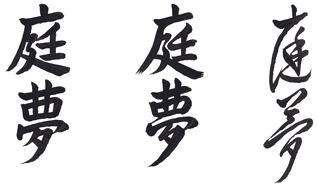
Tim written phonetically in kanji meaning "garden dream"
With kanji, we can use all of the calligraphy fonts — block (kaisho), semi-cursive (gyōsho), and cursive (sōsho). Here Kelly is shown in all three:
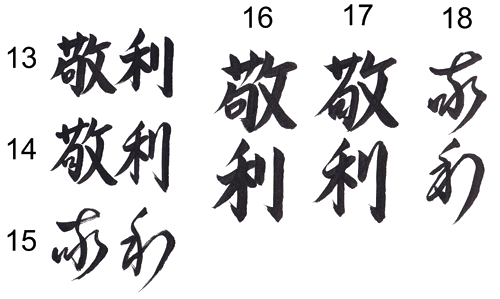
Kelly written phonetically in kanji meaning "Respect and Reason," shown in block, semi-cursive, and cursive scripts.
When Ateji Works Best
A phonetic translation to kanji works best when the name has one to three syllables. Shorter names offer more choices per position, making it easier to find kanji with both the right sound and a pleasing meaning.
Constraints and Difficulties
Name length. Each syllable of the Japanese pronunciation requires its own kanji. Most Japanese given names use two characters; surnames also use two. A foreign name that extends to four or five kanji is unusually long and makes finding a consistent, meaningful combination much harder.
The name Adriana, for example, has four syllables in its Japanese rendering (eidorianna) and would require at least four kanji. It is also difficult to find a consistent and meaningful translation for such a long name. A better approach would be to use a nickname: Adrie becomes eidori — two or three kanji, much more suitable.
Similarly, Timothy would be teimoshī — rather long at three or more characters. But Tim translates neatly to two kanji.
Missing sounds. Katakana has been extended to represent sounds that simply do not exist in native Japanese. These extended sounds have no kanji equivalent. For example, the name Jennifer is jenifā in katakana — but there are no kanji with the readings "je" or "fa." To write Jennifer in kanji, one must expand these to their component sounds: jienifua, requiring five characters. That is very long for a first name.
A practical solution is to use a nickname. Jenny would require three kanji — for example, 慈 (ji, "mercy"), 恵 (e, "grace"), and 仁 (ni, "benevolence").
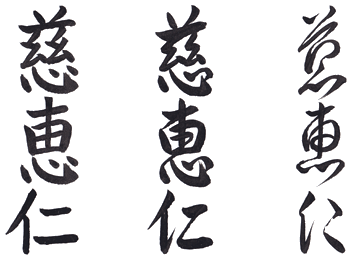
Jenny written phonetically in kanji meaning "mercy, grace, benevolence"
Limited kanji for certain sounds. Some syllables common in Western names have very few kanji with appropriate meanings. Two notable examples: he (as in Helen) and ra (as in Randy). For he, the solution is to substitute the similar-sounding hei, which offers better options.
Consider the name Petra — a beautiful and feminine name. There is no kanji with a natural pe sound. (One gets a pe sound when he follows certain consonant patterns, but not as a word-initial reading.) The solution: use kanji with the reading hei. So for Petra, we use 平 (hei, "gentle, peaceful") and 虎 (tora, "tiger") — "gentle tiger."
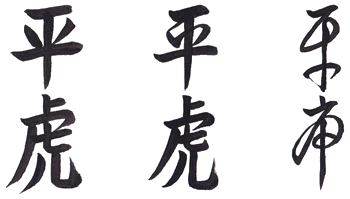
Petra written phonetically in kanji meaning "gentle tiger"
The vowel length mark does not exist in kanji. The chōonpu (ー) used in katakana has no kanji equivalent. Long vowels at the end of names are simply omitted. This is why you will see osukā as the romaji for a katakana translation but osuka for a kanji translation. For aesthetic balance, or if a particularly meaningful kanji can be found, the vowel may sometimes be rendered as an additional character.
The Reading Problem
Each kanji can have many possible pronunciations. The character 平 alone can be read as hei, hyō, hira, taira, tara, hachi, hi, hitoshi, he, or hen — over ten different readings. This means most people will not be able to read an ateji name correctly on first sight.
The Japanese deal with this exact problem for their own names. The solution is the name card (meishi), which shows not only the kanji but also the proper reading in small kana above each character (called furigana). So while people may not immediately read your ateji name correctly, if you explain it, they will understand it — just as they would with an unusual Japanese name.
Literal Translation
With a literal translation, the meaning of the name is translated rather than the sound. The pronunciation changes entirely, but the meaning carries through.
Many names are words with known meanings — sometimes beautiful ones. The name "Angel" because one's child is like an angel. The name "Joy" for the happiness a child brings. A literal translation preserves this meaning in Japanese.
How It Works
The meaning of the name is determined (often from its etymology), and then an appropriate Japanese word is found. The name Kelly, from the Gaelic ceallach, means "war." The translation becomes 戦士 (senshi), meaning "warrior."
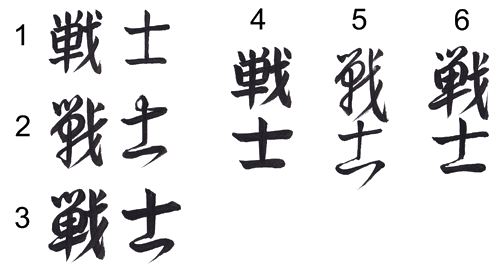
Kelly written literally in kanji meaning "warrior," read senshi
The name Liberty translates to 自由 (jiyū), meaning "freedom; liberty."
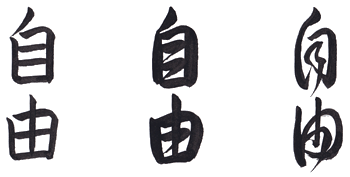
Liberty written literally in kanji read jiyū
Names Well Suited for Literal Translation
Names that are common words translate particularly well:
| Name | Japanese | Romaji | Meaning |
|---|---|---|---|
| Amber | 琥珀 | kohaku | Amber (the gemstone) |
| Fawn | 子鹿 | kojika | Young deer |
| Forrest | 森林 | shinrin | Forest |
| Hunter | 狩人 | kariudo | Hunter |
| Ruby | 紅玉 | kōgyoku | Ruby (lit. "crimson jewel") |
| Star | 星 | hoshi | Star |
The name Joy is a good example of when a literal translation may be preferred for artistic reasons as well. Joy can be translated phonetically as 上位 (jōi, "superior"), but the literal translation 喜 (yorokobi, "joy") preserves the original beauty of the name.
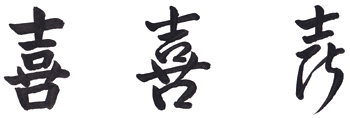
Joy in kanji read yorokobi
From the example above, one can even see a visual similarity between Joy in English and in kanji.
A Note on Pronunciation
I should mention that in Japan one does find names written in kanji but pronounced in English. The name Angel is written 天使, which is normally read tenshi. But some Japanese write 天使 and insist the reading is enjeru (Angel). Similarly, Rose in Japanese is 薔薇 (bara), but some write 薔薇 and use the reading "rōzu" (Rose). A literal translation may take on either its Japanese pronunciation or its original — the owner of the name decides.
When Literal Translation Does Not Work
Unknown meaning. The meaning of several ancient names has been lost. Adriana means "from Adria," a place name whose original meaning is unknown — there is nothing to translate.
Undesirable meaning. Calvin means "bald." Brody means "ditch." Some may not wish to preserve these meanings in their Japanese name.
No common Japanese word. Lyndon (from the Linden tree) and Ashley (from the Ash tree) have scientific names in Japanese but no common words. A literal translation would be obscure.
For these cases, a phonetic translation — to katakana, hiragana, or kanji (ateji) — is the better choice.
An Advantage of Literal Translation
One benefit: a literal translation does not depend on pronunciation. The name "Jan" — whether pronounced with a J (American) or a Y (European) — has the same meaning ("God is Gracious") either way. The literal translation to Japanese is the same regardless of how you say the name: 神恵 (shinkei).
A Word of Caution
Translating names to kanji — whether phonetically or literally — requires genuine expertise. Two cautionary examples come to mind.
One person wanted "Casanova" translated as "Lover." Using a literal translation from a dictionary, the version they selected was aijin — which means lover as in a mistress. Certainly not the intended meaning.
In another case, someone wanted a name meaning "heaven" and selected an archaic reading of the kanji 乾. While one of its ancient meanings is indeed "heaven," this meaning is no longer taught. Modern Japanese readers would read it as kawaku, meaning "to dry out."
An excellent resource for finding the original meanings of names is Behind the Name — The Etymology and History of First Names. But once the meaning is determined, a knowledgeable translator who understands modern usage is essential.
I personally select kanji for each name design, ensuring that the meaning is appropriate, the composition is artistically balanced, and no unfortunate readings lurk beneath the surface. This is where calligraphy becomes personal art — no two kanji name designs carry exactly the same message.
Summary
Kanji brings meaning to your Japanese name — something that the phonetic scripts cannot offer. Whether through ateji (sound + meaning) or literal translation (meaning alone), kanji opens the full range of calligraphy fonts and seal scripts while making each design uniquely personal.
For the standard phonetic rendering, see How to Write Names in Katakana. For flowing cursive designs, see How to Write Names in Hiragana.