
How to Write Names in Katakana
Katakana is the standard way to write non-Japanese names in Japanese. After the end of World War II, as part of a process to simplify the Japanese language, it was established that all non-Japanese words and names were to be written using katakana. This is how foreign names appear in Japanese newspapers, magazines, and on Wikipedia today. It is what I recommend for most customers who want their name in Japanese.
For an overview of all four methods of writing names in Japanese, see How to Write Names in Japanese.
What Is Katakana?
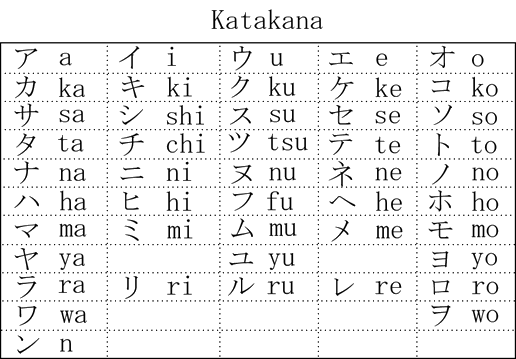
Katakana 片仮名 is a syllabary — each character represents a syllable, not a letter, and each character has no meaning on its own. The strokes are angular and crisp, giving katakana a modern, assertive appearance.
Each katakana character is a simplified form of a kanji (Chinese) character. Its creation is attributed to the monk scholar Kibi no Makibi (AD 693–755) and was the first Japanese syllabary developed. Initially used as a pronunciation aid for Buddhist scriptures, katakana was later used for grammatical elements just as hiragana is today. In modern Japanese, katakana is reserved for foreign words, names, and technical terms.
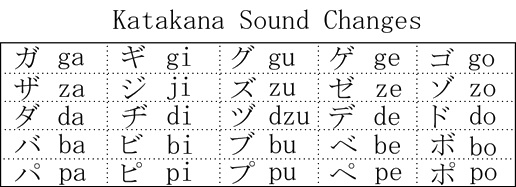
Sound Changes: Dakuten and Handakuten
Along with the basic characters, katakana uses two modifiers to create additional sounds.
The dakuten 濁点 looks like a double quotation mark and voices the consonant. The handakuten 半濁点 looks like a small circle. For example, ハ (ha) with dakuten becomes バ (ba), and with handakuten becomes パ (pa).
Combinations and Small Characters
Several modifiers called shōji 小字 (small characters) create new sounds. The small ya, yu, and yo — called yōon 拗音 — modify the preceding character to create palatalized syllables.
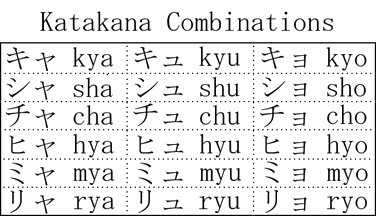
The small tsu, called sokuon 促音, appears before certain characters and doubles or emphasizes the following consonant. For example, the name "Duke" is written dukku in romaji and デュック in katakana. The small tsu places emphasis on the "k" sound, distinguishing it from duku デュク, which would not emphasize either syllable. Notice also the small yu (a yōon) which modifies "de" to create a "du" sound.
Extended Katakana for Foreign Sounds
This is where katakana truly distinguishes itself from hiragana. Over the years, katakana has been extended with combinations that do not exist in native Japanese, specifically to handle foreign pronunciations more accurately:
| Katakana | Romaji | Sound | Example |
|---|---|---|---|
| ティ | ti | English "tea" | Timothy → timoshī |
| ディ | di | English "dee" | Diana → daiana |
| ファ | fa | English "fa" | Fawn → fōn |
| フィ | fi | English "fee" | Philip → firippu |
| ヴ | vu | English "v" | Steve → sutīvu |
| ヴァ | va | "va" | Valerie → varerī |
| ヴィ | vi | "vee" | Vivian → vivian ヴィヴィアン |
| ウィ | wi | "wee" | William → uiriamu |
| ウェ | we | "weh" | Wesley → uesurī |
| トゥ | tu | "too" | Tudor → tūdā |
These small combining characters (small a, i, u, e, o) allow katakana to approximate sounds that the native syllabary cannot represent. This is why katakana is considered the most accurate phonetic rendering of foreign names.
Long Vowels: The Chōonpu
The chōonpu 長音符 is a dash-like mark (ー) that extends the vowel sound of the preceding character. This corresponds to the dash written in romaji. For example, the name Kelly ends with a long "ee" sound: ケリー (kerī). The ー stretches the "i" sound of リ.
The chōonpu is the only Japanese character that changes orientation depending on whether the text is written horizontally or vertically:
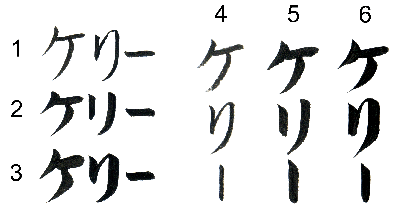
Kelly written in katakana horizontally from left to right and vertically from top to bottom.
How Your Name Adapts
Because Japanese organizes sound differently from English and most European languages — nearly every syllable is one consonant followed by one vowel — foreign names must be rebuilt from Japanese syllables. Here is what happens:
Consonant clusters split apart
Japanese does not allow two consonants in a row (except the doubled consonant sokuon). Each consonant gains its own vowel, usually "u," though after T and D it is typically "o":
| Name | English syllables | Japanese syllables | Why |
|---|---|---|---|
| Brian | BRYE-un (2) | bu-ra-i-a-n (5) | "br" splits to "bu-ra" |
| Smith | SMITH (1) | su-mi-su (3) | "sm" and final "th" each gain vowels |
| Christine | KRIS-teen (2) | ku-ri-su-ti-n (5) | Every cluster splits |
Final consonants gain vowels
English names frequently end on consonants. Japanese names almost never do (the only exception is the syllabic n). So final consonants gain a following vowel:
| Name | Final sound | Japanese | Result |
|---|---|---|---|
| Mark | -rk | ma-ru-ku | "r" gets "u," "k" gets "u" |
| Brad | -d | bu-ra-do | "d" gets "o" |
| Steve | -v | su-tī-vu | "v" gets "u" |
Some sounds substitute
Sounds that do not exist in Japanese map to established equivalents:
- L and R both use the R-column kana (ラ, リ, ル, レ, ロ). The Japanese sound is a light tap of the tongue, somewhere between an English L and R.
- TH (voiceless, as in "Catherine") maps to S: キャサリン (kyasarin). TH (voiced, as in "the") maps to D.
- V uses the extended ヴ series: ヴァ, ヴィ, ヴ, ヴェ, ヴォ. Historically, V was written with B, so older references may show Steve as スティーブ (sutību) rather than the modern スティーヴ (sutīvu).
Examples
Arthur is written in romaji as āsā. There is no "th" sound, so it becomes sa. The "r" before "th" and the final "r" cannot stand alone, so both become the long vowel mark. Arthur in katakana is アーサー.
As another example, Japanese does not have the "thy" ending in Kathy and Timothy. These are replaced with shī. So Kathy is kyashī キャシー and Timothy is timoshī ティモシー.
Brian is buraian ブライアン, which may seem counterintuitive. Names are written by how they are pronounced, not by how they are spelled. The "B" alone becomes the syllable bu because the following "r" creates a consonant cluster that must be split.
Pronunciation, Not Spelling
One point bears emphasis: names are translated by how they are pronounced, never by how they are spelled. "Kathy" and "Cathy" produce identical katakana. "Jan" with a J and "Jan" with a Y produce different katakana. Our system handles names from 13 languages, because the same spelling can sound very different depending on the language of origin. For more on this, see the overview article.
Katakana and Japanese Seals
One problem with katakana is also its strength: the simple, angular lines are easy to write quickly, but they leave little room for artistry. Katakana has no cursive or even most semi-cursive fonts. Much of Japanese calligraphy's expression simply cannot be used with katakana.
This creates a particular problem with seals. "Seal Script" (tensho) has been used for seals for thousands of years — its complex, curving strokes make forgery difficult. But Seal Scripts predate katakana by several thousand years and are defined only for kanji. Using katakana for a seal means breaking either the rule that foreign names use katakana or the rule that seals use tensho. One rule must give way.
In Japan there are two types of seals. The inkan is used for everyday purposes — one could buy a pre-made inkan at a stationery store. The tenkoku (literally "Seal Script carving") is for legal purposes such as opening a bank account. A tenkoku must be unique and complex, registered with the government. For this purpose, kanji and Seal Script are essential.
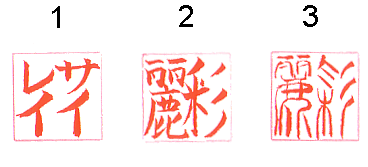
To illustrate the difference, above are different seals for Sairei, my professional name in Japan, showing three different seal styles.
For seal designs, consider using a phonetic or literal translation to kanji instead, which allows the full range of seal scripts.
Translating Initials
As Japanese is a language of syllables, translating individual letters is awkward. The method is to translate how each letter is pronounced. The letter "A" is pronounced "ay" and becomes エー (ē). The single letter "W" takes five kana to write: ダブリュー (daburyū).
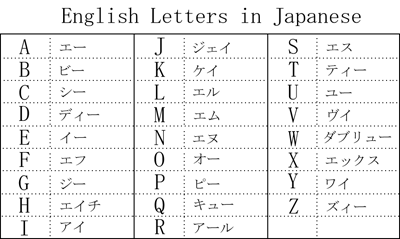
As an example, IBM's legal name in Japan is partly written as アイ・ビー・エム (ai bī emu). The middle dot (・) is used as a separator between initials.
Summary
Katakana is the standard, accurate, and immediately recognizable way to write foreign names in Japanese. Its extended character set handles sounds that neither hiragana nor kanji can represent. The trade-off is one I encounter daily in my work: the angular strokes that make katakana clear and efficient also limit what a calligrapher can do with it.
For designs where flowing brushwork matters, consider hiragana. For designs that carry meaning or require seal script, consider kanji.